I've moved this blog to our website www.visualinsight.net -- please visit us there!
Sunday, June 26, 2011


Saturday, January 16, 2010

Sketch created during our planning session for Program for the Future 2010
CoLABoration at The Tech Museum www.programforthefuture.org
Coss-discipline, cross-industry groups experimenting with new collaboration tools and processes to help our own organizations -- while working together to solve global problems
Wednesday, January 06, 2010
1990-2010 Click to enlarge for details of the wild ride technology has taken us on

Looking back over the 20 years since the advent WorldWideWeb, I remember back when scientists were the only ones who had this magical thing called "bitnet" that let them send messages instantly by computer. Then came the days of dial-up and amazement when "you've got mail." In the late 1990's and early 2000's when we were forecasting the impact of technology on education, school administrators were worried about how to wire their buildings. Who knew that soon wires and computers would become passe for students who can do it all with cell phones. So much of what seemed outrageous at the time is commonplace today: "Your Life on a Card," "Video Games Prepare You for the Workforce." In 2001 our Window Into Talent forecast Social Networks at the center of workforce issues, and no one was sure what that meant (years before Facebook).
Now I'm wondering: Which ideas that seem outrageous today will be commonplace in 10 or 20 years? How about "we raised our collective IQ with new technologies and systems for improving human interactions that will enable us to solve global problems"....or at least figured out how to keep cell phones from going off during concerts.

Looking back over the 20 years since the advent WorldWideWeb, I remember back when scientists were the only ones who had this magical thing called "bitnet" that let them send messages instantly by computer. Then came the days of dial-up and amazement when "you've got mail." In the late 1990's and early 2000's when we were forecasting the impact of technology on education, school administrators were worried about how to wire their buildings. Who knew that soon wires and computers would become passe for students who can do it all with cell phones. So much of what seemed outrageous at the time is commonplace today: "Your Life on a Card," "Video Games Prepare You for the Workforce." In 2001 our Window Into Talent forecast Social Networks at the center of workforce issues, and no one was sure what that meant (years before Facebook).
Now I'm wondering: Which ideas that seem outrageous today will be commonplace in 10 or 20 years? How about "we raised our collective IQ with new technologies and systems for improving human interactions that will enable us to solve global problems"....or at least figured out how to keep cell phones from going off during concerts.
Friday, October 02, 2009

The concept of "triangle leadership" came up during this 2006 visit to Bear Island, Buckminster Fuller's family home. Three of us were talking after visiting the geodesic dome: Bonnie DeVarco, visionary and Fuller scholar, Lauralee Alben, designer and leadership consultant, and me. We were inspired by the geometry of the dome to start thinking about the structure of relationships in an organization. Interlocking triangles are strong!
The idea seemed beautifully simple. A very strong triangle of people is a solid beginning. Then the organization builds as each person brings in someone else, and a new triangle (with two of the three originals and the new person) is formed. That way, the relationships are all "interlocking" (everyone is part of a trusted group of three). There may be homogeneity within a triangle, but as the organization grows, a great diversity of people will come together. As the organization grows, each person may not be "bonded" with all the other parts -- but they have a secure initial spot.
In theory, it works to the extent that there is attention to maintaining the closest bonds. In the beginning, each person bonds with two others. Ultimately each person would be connected to adjacent triangles: That would require maintaining bonds with six people. That's a lot to maintain for the bonds to hold. We've put it into practice in a couple of volunteer organizations and it works, but the challenge is to sustain the bonds when there's limited time and energy for the work. A common challenge with any structure.
Bob Johansen of Institute for the Future has written about the "Fishnet Organization"-- the idea being that you could pick it up at any point and the organization could mobilize to serve the whole.
My good colleague Joel Orr wrote a book with the title "Structure is Destiny" and I've observed his ability to apply Nature's principles of design to human endeavors.
GE's former CEO Jack Welch was famous for talking about the importance of human factors in business. But anyone leading an organization knows it's hard. Harder than geometry.
Monday, September 07, 2009

Dogu, the 2500-5000 year old clay figurines from Japan, tell the story of a culture that celebrated women and fertility. I was enchanted by these artifacts at the National History Museum in Oeno Park, Tokyo, Japan last week. And found myself wondering what story historians 2500 years from now (yes - I'm a optimist) will tell about us, based on our artistic artifacts?
********
Background: Quote from Suite 101 The Power of Dogu – Exhibition Preview: Ancient Japanese Ceramic Figurines Will be Shown at British Museum
Dogu are ceramic figures with animal or human features. They were produced using high quality pottery in a wide variety of shapes and sizes with curious decoration and intricate geometric designs. A number of techniques were employed including modelling, clay appliqué, decoration with twisted plant fibres (jomon means ‘cord-marked’) and burnishing. Many were painted, usually with red pigments, or covered with lacquer.
Some have definite female features while many others are not gender-specific. Some figures wear facial masks, while others have heart-shaped faces or triangular heads. Some dogu appear to be praying while many females squat as if in childbirth.
Friday, September 04, 2009
Confessions of a Paper Lover

Recalling the Native American tradition of giving thanks for animals who gave their lives to be a meal -- I'm ready to start doing the same for the trees that produced my main source of sustenance. Yes I consume paper and cannot live without it. I want to be green and save trees. Yes the virtual world works in many ways (e.g., right now -- writing this confession to paper addiction). But cannot imagine ever replacing paper for:
Writing on the Walls: I work on 4 foot by 8 foot (or looooonger) sheets of paper on the walls, weaving words and images to help people at meetings see how their ideas fit together. Yes, there are tree-saving alternatives: Erasable white boards, tablet PCs, even mini e-drawing tablets with mock pastels. But for me the magic seems to be in the paper. I have to touch it with my hands, spread pastels with my fingers, and hear the squeak of the marker on the paper. Awaiting the electronic solution that will leave my hands and conscience clean.
Binders: For every book and research project, I create binders with print-outs of writing -- yes, paper, paper, paper. The thicker they are, the more I feel I've accomplished. The final publication is usually a slim volume, but the binders behind it let me feel the weight of the work behind it. I understand the new Microsoft table shows the "layers" of work, but will it be the same if you can't feel how heavy it is?
Then of course there are books, newspapers, letters, postcards....I could write more but am running out of ideas and must return to my notebook and pen.
Recalling the Native American tradition of giving thanks for animals who gave their lives to be a meal -- I'm ready to start doing the same for the trees that produced my main source of sustenance. Yes I consume paper and cannot live without it. I want to be green and save trees. Yes the virtual world works in many ways (e.g., right now -- writing this confession to paper addiction). But cannot imagine ever replacing paper for:
Writing on the Walls: I work on 4 foot by 8 foot (or looooonger) sheets of paper on the walls, weaving words and images to help people at meetings see how their ideas fit together. Yes, there are tree-saving alternatives: Erasable white boards, tablet PCs, even mini e-drawing tablets with mock pastels. But for me the magic seems to be in the paper. I have to touch it with my hands, spread pastels with my fingers, and hear the squeak of the marker on the paper. Awaiting the electronic solution that will leave my hands and conscience clean.
Binders: For every book and research project, I create binders with print-outs of writing -- yes, paper, paper, paper. The thicker they are, the more I feel I've accomplished. The final publication is usually a slim volume, but the binders behind it let me feel the weight of the work behind it. I understand the new Microsoft table shows the "layers" of work, but will it be the same if you can't feel how heavy it is?
Then of course there are books, newspapers, letters, postcards....I could write more but am running out of ideas and must return to my notebook and pen.
Sunday, May 20, 2007


LOOKING BEYOND THE TRENDS--Joel Orr of Cyon Research identified that fascination with new trends + ennui with old ones = shallow thinking. For example, the term "globalization" has been on the lips of most business and thought leaders for a few years. Been there, done that. But in reality we have only begun to fathom the impacts and implications. At Cyon's annual "Conference on the Future of Engineering Software" (for which we created this mural), the focus was on deeper thinking, stronger networks, and better data for getting the big picture of the sea change we're experiencing.
Friday, September 08, 2006

Do visuals impact the brain differently than text? Yes of course, but how? Bonnie DeVarco and I are exploring that in our book and Bonnie just passed along this link about a conference last Spring where artists and scientists came together to exchange information: Visuals
Thursday, July 13, 2006
Communications consultant Natalie Shell has an excellent perspective on risk-taking. How many of us could produce a "failure resume/CV"? A new aspiration!
Natalie'sBlog
Natalie'sBlog
Monday, March 20, 2006

What if an elementary school teacher could have instant access to all the online resoures from the best science museums, tailored precisely to the state education standards -- and to interest level of her students? That question led Dr. Ted Kahn to create the San Francisco Bay Area School-Museum Collaboratory. All the great resources from the 9 Bay Area science museums have been linked to the specific standards so teachers can click and get an experiment, a drawing, a story to go with what they are teaching. Programming genius Jack Park created the back end structure (inspired by the ideas of Doug Engelbart/Ted Nelson- Ted asked me to create simple graphics for the pages. Teachers tell us the simple drawings helps the navigation and material feel more accessible. Here's a link to the 5th grade site. ScienceCollaboratory
Wednesday, March 08, 2006
IS THERE A "SHAPE" TO THOUGHT? That is one of the questions Bonnie DeVarco and I raise in our book CodeX: Unlocking the Power of Visual Language, and we find the answer yes in the interwoven stories of certain pieces of literature, music, art, symbols, and patterns that resonate with Nature, across generations and geographies. Why do certain experiences just feel "right" to so many people? Bill Daul sent me a link to a video clip that speaks volumes about the shape of thought in several natural languages--body, music, physics, dance-- Chris Bliss juggling to a song from Abbey Road.
THIS IS A MUST SEE (Click on link to "finale)
THIS IS A MUST SEE (Click on link to "finale)
Friday, February 24, 2006
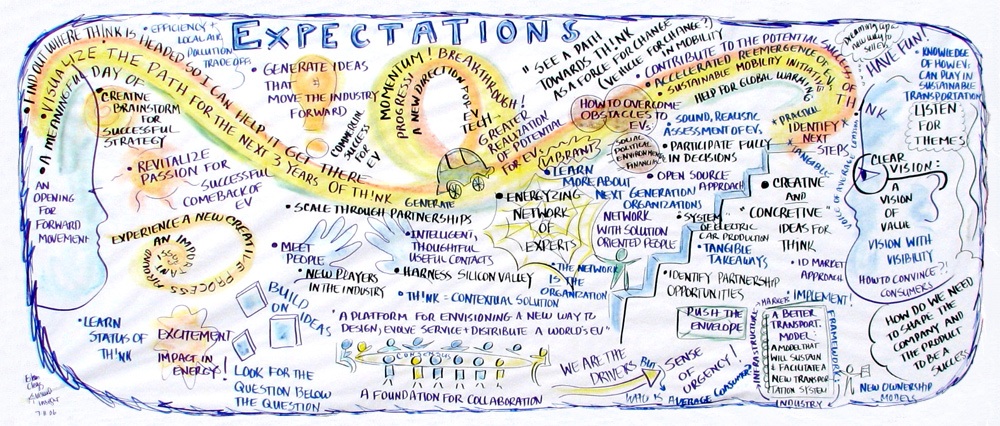
GOOGLE DOODLES. The Time magazine piece about Google (2/4/06) shows a lot of writing on the walls, another piece of evidence for emergent visual storytelling as a tool for innovation. Interesting to note: These doodle on these links clearly are the work of the participants, not a professional artist. At Visual Insight we encourage everyone to write on the walls, letting go of worry about perfection. Bringing in a professional visual journalist is a good idea when (1) you want an objective outside listener to pick up the themes (2) you want to capture the final product for a visual book or report. (See link to the Th!nk Electric car event at Google where the above mural was created Th!nk at Google But in any meeting anyone can spark the brainstorming process with random images and words. They have a way of coming together in surprising ways new ideas. (Thanks to colleage Christine Walker for bringing this to our attention)
Monday, January 09, 2006

Here is an animation of one of my murals. The idea: have a mural unfold images that inspire and relax the brain concurrent with podcasts: Eileen's animated mural
Sunday, January 08, 2006
Thursday, January 05, 2006

GOOGLE VS. GOLIATH (or maybe Google now is Goliath?)
Blogs Buzzing With Google PC Report :: http://tinyurl.com/ap4vt
A Los Angeles Times story says the search-engine company has been chatting
with Wal-Mart and others to sell a computer that would run a
Google-developed operating system, not Microsoft's Windows.
(thanks John Maloney)
Blogs Buzzing With Google PC Report :: http://tinyurl.com/ap4vt
A Los Angeles Times story says the search-engine company has been chatting
with Wal-Mart and others to sell a computer that would run a
Google-developed operating system, not Microsoft's Windows.
(thanks John Maloney)
Wednesday, January 04, 2006

THE END OF JOBS?
At the Future of Talent conference in October, Verna Allee talked about a day when traditional "jobs" could disappear and instead companies would have ongoing relationship with a "value network" of people who would move in and out of projects. Then at Elliott Masie's Learning 2005 in November, author Malcolm Gladwell predicted the "tipping point" for society would be the changing relationship between people and their employers (above is my mural of Gladwell's talk). I'm hearing more and more conversations about implications implications. What is the role of schools in preparing students for network-employment. What about health insurance, professional development and other benefits? Some are suggesting this is a new calling for old unions. The paradigm has already shifted for individuals. A lot of us whose work is based in Silicon Valley have our own small companies and affiliations with larger organizations, moving between projects. It helps to have a spouse with traditional employment. I'm looking for examples of small businesses or individual freelancers who have gotten together to address these issues. (Thanks, Robert Scoble and Anthony Townsend for inspiration to return to posting images on the blog!)
SMART VISUAL BLOGS. Anthony Weeks, fellow visual pratitioner, created a visual log of Robert Scoble's latest talk. Scoble is the blog guru we wrote about a couple of days ago after his session at Doug Engelbart's. This kind nof post is helping visual journalism come to life!
Monday, January 02, 2006
BLOGGING GETS REAL
By Jeff Saperstein and Eileen Clegg
Last year blogging was a curiosity to most people; today it is a force. Blogging is changing journalism, marketing, the way people are engaging with each other, and the power structure of society.
The blogging revolution was explained by Robert Scoble of Microsoft, during a New Years Day meeting at the home of Douglas C. Engelbart, technology visionary and inventor of the computer mouse. The venue was not a Microsoft platform; in fact, Engelbart once stridently walked out of a project with Microsoft. Scoble faced a collection of open-minded but somewhat skeptical writers, educators and inventors who are part of our loose-knit community of practice called the Next Now.
Scoble, who started blogging five years ago, offered a surprising theory about why blogging got started in the first place and, more important, he explained what is going on behind the scenes to make blogs serious business.
People are using blogs as a running journal. People record their thoughts, then other people react, and there is a dialogue. If it’s something topical—Hurricaine Katrina, the Xbox, the truth about your company or product—your blog may be faster and more accurate than traditional sources.
How did blogging get started? Scoble said that after the year 2001 tech economy crash, people were laid off and had time on their hands. They were bent out of shape about corporate scandals and wanted a voice. They were looking for work and needed to communicate with each other. They could be a neutral source of information – sifting through the hype about products. It worked for Scoble, who helped run the camera section of LZ Premiums in the 1980s and early 1990s and began his blog to write about different camera products. People read him because he had no vested interest in one manufacturer over another.
A few years back, you had to be pretty savvy to start a blog but now the barrier to entry is low. Anyone can start one. But not everyone makes it to the top of the list. Yes there is a list, and it is based on qualitative not just quantitative factors.
It’s not how many people link to your blog, but who they are. Somewhere there is a map of who is linking to whom. The search engines are driving this. It’s not just like posting bulletin boards. It’s not anarchy. If someone deemed highly credible links to your blog, your blog moves up the list. The links and rationale are all transparent. But qualitative evaluation of the blogger’s authenticity, veracity, and knowledge as well as how well they respond to comments, criticism, and corrections also counts. A good buzz sets off alarm bells.
Scoble gave five reasons for blogging:
1. It’s easy to publish. There are particular sites that get you started: blogger.com, typepad.com wordpress.com Anyone can create a blog without it being a big production
2. Discoverability. In the old days, to get discovered, you had to pay for it. Today, Google knows about you and tracks the quality of response to your blog and which experts are linking to you and that’s how you get discovered.
3. Conversationality. People can go back and forth, commenting on each other’s blogs.
4. PermaLinking. Instantly there is a record of posts, whose linking to whom. It’s all transparent.
5. Syndication. There is a “human filter.” People can create RSS feeds (RSS=real simple syndication), enabling them to see who’s writing about topics of interest. People can choose not only link to your blog but the parts of your blog that are getting the most feedback.
What are the implications for marketing? Consumers are paying attention to what bloggers are saying about a product. It’s a new journalism. If bloggers are saying that a product really sucks, people listen. Companies have the choice to respond to the feedback. Instead of press releases, people are listening to each other to learn about what’s hot, what’s not?
In the past, product marketing and communication has been a one-way street. Today, you can’t stop people from making comments about your products – in real time. Scoble says smart companies let employees blog and talk to customers instead of relying solely on a public relations department being responsible for all external communications.
Companies profit by empowering employees to monitor blogs. For example, Scoble said, Microsoft is monitoring blogs, and responding to complaints by writing back, “we’re hearing you….” It works to bring down the anger level. Microsoft can say, “we saw your blog and we want to address the problem.”
Being blog-savvy is a necessary current competency for companies.
But what about blogging for individual, ordinary people? Scoble said the best blog is when you are passionate and authoritative. You can designate different parts of your blog for different subjects and interest or just integrate everything into a running journal. People want reality. The best blog is informative, but the passion has to come through. People who share your passion will link to your blog.
Blogging is learning, Scoble said. You learn by the response you get on your blog. In traditional communications, there is an expert telling you how it is. In a blog, you are looking for response. If you are dealing with a service or product, you will get very good feedback even if some of it is critical.
How you deal with that feedback is critical. If you don’t want to listen, you are not going to have a good blog. If you are completely defensive, you will be out of the game. If you are open to listening and ready to engage, you will create a dialogue and everyone benefits, according to Scoble.
An interesting metaphor: The Jewish Talmud was developed by people responding to each other through commentaries over the centuries about a particular passages in the Bible. From that interaction, the Jewish laws emerged. Blogging expands this Talmudic practice, but enabling everyone to apply it to everything. People developed laws for living based on the asynchronous dialogue of rabbis over the centuries. In different disciplines today, instead of centuries, the dialogue is instantaneous.
(This article is based on the synthesis of Robert Scoble’s talk by Jeff Saperstein as related to Eileen Clegg on January 1, 2006. The meeting was convened by Bill Daul, leader of the Next Now: . Jeff will be starting a blog soon; visit his website at JEFF SAPERSTEIN Wikipedia entry about Scoble’s is ROBERT SCOBLE)
Please add your thoughts!
By Jeff Saperstein and Eileen Clegg
Last year blogging was a curiosity to most people; today it is a force. Blogging is changing journalism, marketing, the way people are engaging with each other, and the power structure of society.
The blogging revolution was explained by Robert Scoble of Microsoft, during a New Years Day meeting at the home of Douglas C. Engelbart, technology visionary and inventor of the computer mouse. The venue was not a Microsoft platform; in fact, Engelbart once stridently walked out of a project with Microsoft. Scoble faced a collection of open-minded but somewhat skeptical writers, educators and inventors who are part of our loose-knit community of practice called the Next Now.
Scoble, who started blogging five years ago, offered a surprising theory about why blogging got started in the first place and, more important, he explained what is going on behind the scenes to make blogs serious business.
People are using blogs as a running journal. People record their thoughts, then other people react, and there is a dialogue. If it’s something topical—Hurricaine Katrina, the Xbox, the truth about your company or product—your blog may be faster and more accurate than traditional sources.
How did blogging get started? Scoble said that after the year 2001 tech economy crash, people were laid off and had time on their hands. They were bent out of shape about corporate scandals and wanted a voice. They were looking for work and needed to communicate with each other. They could be a neutral source of information – sifting through the hype about products. It worked for Scoble, who helped run the camera section of LZ Premiums in the 1980s and early 1990s and began his blog to write about different camera products. People read him because he had no vested interest in one manufacturer over another.
A few years back, you had to be pretty savvy to start a blog but now the barrier to entry is low. Anyone can start one. But not everyone makes it to the top of the list. Yes there is a list, and it is based on qualitative not just quantitative factors.
It’s not how many people link to your blog, but who they are. Somewhere there is a map of who is linking to whom. The search engines are driving this. It’s not just like posting bulletin boards. It’s not anarchy. If someone deemed highly credible links to your blog, your blog moves up the list. The links and rationale are all transparent. But qualitative evaluation of the blogger’s authenticity, veracity, and knowledge as well as how well they respond to comments, criticism, and corrections also counts. A good buzz sets off alarm bells.
Scoble gave five reasons for blogging:
1. It’s easy to publish. There are particular sites that get you started: blogger.com, typepad.com wordpress.com Anyone can create a blog without it being a big production
2. Discoverability. In the old days, to get discovered, you had to pay for it. Today, Google knows about you and tracks the quality of response to your blog and which experts are linking to you and that’s how you get discovered.
3. Conversationality. People can go back and forth, commenting on each other’s blogs.
4. PermaLinking. Instantly there is a record of posts, whose linking to whom. It’s all transparent.
5. Syndication. There is a “human filter.” People can create RSS feeds (RSS=real simple syndication), enabling them to see who’s writing about topics of interest. People can choose not only link to your blog but the parts of your blog that are getting the most feedback.
What are the implications for marketing? Consumers are paying attention to what bloggers are saying about a product. It’s a new journalism. If bloggers are saying that a product really sucks, people listen. Companies have the choice to respond to the feedback. Instead of press releases, people are listening to each other to learn about what’s hot, what’s not?
In the past, product marketing and communication has been a one-way street. Today, you can’t stop people from making comments about your products – in real time. Scoble says smart companies let employees blog and talk to customers instead of relying solely on a public relations department being responsible for all external communications.
Companies profit by empowering employees to monitor blogs. For example, Scoble said, Microsoft is monitoring blogs, and responding to complaints by writing back, “we’re hearing you….” It works to bring down the anger level. Microsoft can say, “we saw your blog and we want to address the problem.”
Being blog-savvy is a necessary current competency for companies.
But what about blogging for individual, ordinary people? Scoble said the best blog is when you are passionate and authoritative. You can designate different parts of your blog for different subjects and interest or just integrate everything into a running journal. People want reality. The best blog is informative, but the passion has to come through. People who share your passion will link to your blog.
Blogging is learning, Scoble said. You learn by the response you get on your blog. In traditional communications, there is an expert telling you how it is. In a blog, you are looking for response. If you are dealing with a service or product, you will get very good feedback even if some of it is critical.
How you deal with that feedback is critical. If you don’t want to listen, you are not going to have a good blog. If you are completely defensive, you will be out of the game. If you are open to listening and ready to engage, you will create a dialogue and everyone benefits, according to Scoble.
An interesting metaphor: The Jewish Talmud was developed by people responding to each other through commentaries over the centuries about a particular passages in the Bible. From that interaction, the Jewish laws emerged. Blogging expands this Talmudic practice, but enabling everyone to apply it to everything. People developed laws for living based on the asynchronous dialogue of rabbis over the centuries. In different disciplines today, instead of centuries, the dialogue is instantaneous.
(This article is based on the synthesis of Robert Scoble’s talk by Jeff Saperstein as related to Eileen Clegg on January 1, 2006. The meeting was convened by Bill Daul, leader of the Next Now: . Jeff will be starting a blog soon; visit his website at JEFF SAPERSTEIN Wikipedia entry about Scoble’s is ROBERT SCOBLE)
Please add your thoughts!
Subscribe to:
Posts (Atom)